
AI can now generate Odoo modules faster than any team can review them. That is exactly the problem. Without Odoo expertise, you get modules that look finished but can’t be maintained, upgraded or audited. Under good architecture, AI is one of the best accelerators Odoo projects have ever had.
Here is a scenario we see more and more often. A growing retailer decides to move off its legacy system onto Odoo Community. The owner knows the business inside out and is technically curious. Instead of hiring an Odoo partner, he opens a chat window and asks an AI assistant to build what the stores need: Point of Sale tweaks, logins, delivery methods, user management, reporting.
A few hundred hours later he has around 30 custom addons and several hundred thousand lines of Python, XML and JavaScript. Everything appears to work in the demo. Then he asks experienced Odoo developers to review it before go-live, and the answer is hard to hear: the system will not survive its next Odoo version upgrade.
This post explains why that happens and how to use AI in Odoo development so this type of failure does not happen.
What does research say about AI for Odoo development
This isn’t just our impression from the projects we have done. Independent studies point the same way: AI writes working code quickly, but security, structure and long-term maintainability suffer unless experienced people control the flow.
-
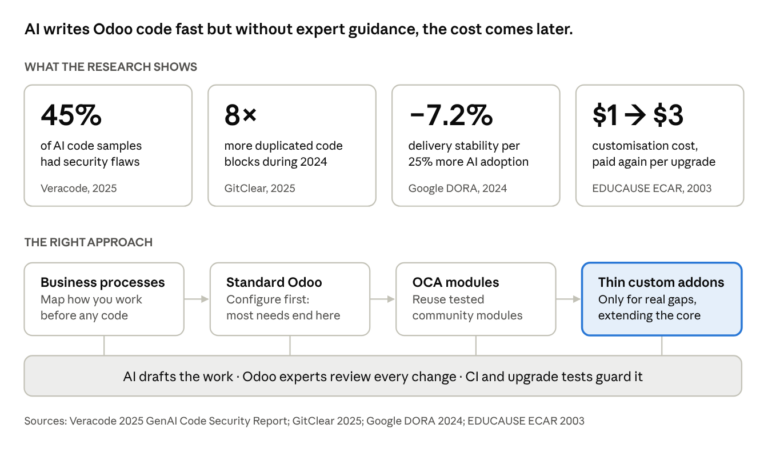
Security: Veracode tested more than 100 language models on 80 coding tasks and found security vulnerabilities in 45% of the generated code. Security performance did not improve as newer models got better at syntax (Veracode, 2025). An earlier peer-reviewed study of GitHub Copilot found about 40% of 1,689 generated programs to be vulnerable (Pearce et al., IEEE S&P 2022).
-
Overconfidence: In a Stanford user study, participants with an AI assistant wrote less secure code than those without one, and were more likely to believe their code was secure (Perry et al., ACM CCS 2023).
-
Maintainability: GitClear’s analysis of 211 million changed lines found that duplicated code blocks rose eightfold during 2024, while refactoring, the sign of code reuse, fell sharply (GitClear, reported by DevClass, 2025). That matches what we see: AI rebuilds instead of reusing.
-
Delivery stability: Google’s DORA research estimated that a 25% increase in AI adoption came with a 7.2% drop in delivery stability (DORA, 2024). Its 2025 report concludes that AI acts as an amplifier: it strengthens good engineering organisations and magnifies the problems of struggling ones (DORA, 2025).
-
ERP customisation cost: ERP research has warned for decades that heavy customisation drives up upgrade and maintenance costs. An EDUCAUSE study found that every dollar spent on customisation during implementation cost about three dollars each time it had to be redone in a later upgrade (EDUCAUSE ECAR, 2003).
Put together: AI makes customisation cheaper to write, but not cheaper to own. In Odoo, with a major release every year, that ownership cost comes back every year. In the image below, the numbers explain why the order matters: every step left of custom code is code you don’t have to secure, maintain or upgrade yourself.

What goes wrong when AI builds Odoo on its own
Unguided AI code fails in predictable ways. The same six patterns show up in almost every review of AI-generated Odoo addons.
|
Pattern |
What it looks like in Odoo |
Why it hurts |
|
Rebuilding the standard |
A custom delivery module instead of Odoo’s carrier and shipping framework; a new password checker instead of the built-in password policy or the OCA password_security module; parallel user and access logic |
You now maintain thousands of lines that Odoo SA and the community would have maintained for free |
|
Hardcoding |
Company names used to force record order, email addresses and UI labels written straight into Python files |
Nothing is configurable or translatable; multi-company setups and Odoo’s translation system break |
|
Dead code |
Methods nothing ever calls, half-finished models, leftover experiments |
Reviewers can’t tell what matters, so every change is risky |
|
Upgrade breakage |
Core methods overwritten instead of extended with _inherit and super(); views replaced instead of patched with XPath |
Every yearly Odoo release breaks something, and the system gets frozen on an old version |
|
Weak security |
Home-grown login flows, missing access rules and record rules, sudo() sprinkled around to make errors go away |
The most sensitive parts of the system are the least tested |
|
Compliance by improvisation |
Custom workarounds for fiscal POS signing, tax reports or audit exports |
In countries with fiscalization laws, such as Germany’s TSE requirement for cash registers, this is a legal risk, not a style issue |
The volume makes it worse. When a codebase is many times larger than the business needs, nobody can review it in a reasonable time. Cleaning it up module by module often costs about as much as building it properly, with a weaker result.
Why it happens: the AI isn’t the problem, the missing Odoo architect is
AI assistants answer the question you ask. Ask for a delivery module and you get a delivery module, written from scratch. The AI won’t stop and say “Odoo already has a shipping framework with carrier integrations, configure that instead” unless someone who knows Odoo asks the right question.
Odoo is not a blank canvas. It is a framework with years of design decisions built in: the ORM and model inheritance, view inheritance, security groups and record rules, the module dependency system, and a release cycle with a new major version every year. Good Odoo code is mostly about fitting into that framework. That knowledge is exactly what a non-expert prompting a general-purpose AI doesn’t have.
We see the contrast inside our own team. Experienced Odoo developers using AI coding tools get very good results, because they challenge the output, know the framework’s caveats and throw away what doesn’t fit. Same tools, completely different outcome. The difference is the human steering them.
How to use AI for Odoo development the right way
The rule is simple: humans own the architecture, AI speeds up the work inside it. In practice that comes down to eight steps.
-
Start from business processes, not code. Write down how a sale happens, how stock moves between stores, who approves what. This is the most valuable asset in any Odoo project, and AI is excellent at helping structure it.
-
Standard Odoo first. For every requirement, check what Odoo already does through configuration: Sales, Inventory, Point of Sale, Accounting and their settings. Most “custom” needs turn out to be configuration.
-
Then the OCA. The Odoo Community Association maintains thousands of tested, reviewed modules. Reusing one beats generating a new one, and it is upgraded with each Odoo version.
-
Do a fit-gap analysis. Map each requirement to standard Odoo, an OCA or Odoo Apps module, or a real gap. Only the real gaps get custom code.
-
Keep custom addons thin. Extend models with _inherit and call super(), patch views with XPath, keep settings in the database through configuration records and system parameters, and wrap user-facing text for translation. No hardcoded company names, emails or labels.
-
Let AI write, let Odoo experts review. AI drafts the module, the tests and the documentation. A senior Odoo developer reviews every merge request before it reaches production.
-
Put guardrails in the pipeline. Follow the OCA coding guidelines and reuse their tooling: pre-commit hooks, pylint-odoo and CI that runs Odoo’s own test framework. Before each Odoo upgrade, run a migration test on a copy of the database.
-
Don’t improvise compliance. Fiscal POS signing (such as a certified cloud TSE in Germany), localization and tax reports should use maintained, standard solutions. Here, boring is a feature.
None of this slows AI down. It points the speed in the right direction.
Where AI really shines in Odoo projects
Used this way, AI saves real time across the whole Odoo project, not only in coding:
-
Requirements: turning workshop notes and interviews into structured process descriptions and user stories.
-
Fit-gap analysis: helping consultants search the Odoo documentation, OCA repositories and the Odoo Apps store for existing solutions.
-
Boilerplate: generating module manifests, views, QWeb reports, access rights files and the repetitive parts of an addon.
-
Tests: writing unit tests and Point of Sale UI tours that developers would otherwise skip under deadline pressure.
-
Code review support: flagging dead code, hardcoded values, unnecessary sudo() calls and core overrides for a human to judge.
-
Data migration: mapping fields from the legacy system to Odoo models and cleaning messy product and partner data.
-
Upgrades: helping adapt custom addons to a new Odoo version once a developer has scoped the changes.
-
Documentation and training: keeping user guides for store staff and technical docs current as the system changes.
In every case, AI produces a draft and someone who understands Odoo decides what ships.
The speed gains are real, but they depend on the task. In a controlled experiment, developers with GitHub Copilot finished a self-contained programming task 55.8% faster (Peng et al., 2023). Yet in a randomised trial on large, mature open-source codebases, experienced developers using AI took 19% longer, even though they believed they were faster (METR, 2025, reported by InfoWorld). Odoo projects are firmly in the second category: large frameworks with many implicit rules. That is exactly why AI belongs in the hands of people who know those rules.

AI for Odoo Development: Speed Without the Technical Debt
AI for Odoo Development: Speed Without the Technical Debt Table of Contents AI can now generate Odoo modules faster than any team can review them. That is exactly the problem. Without Odoo expertise, you get modules that look finished but can’t be maintained, upgraded or audited. Under good architecture, AI is one of the best
Sustainable Software Design: A Strategic Guide for IT Leaders
Sustainable Software Design: A Strategic Guide for IT Leaders Table of Contents Sustainable software design is no longer a CSR side project. In the EU, it now touches energy law, cybersecurity law, consumer law and sustainability reporting, and it directly shapes your cloud bill. For CIOs, CTOs and IT directors in Germany and across Europe,