
Sustainable Software Design: A Strategic Guide for IT Leaders
Table of Contents
Sustainable software design is no longer a CSR side project. In the EU, it now touches energy law, cybersecurity law, consumer law and sustainability reporting, and it directly shapes your cloud bill.
For CIOs, CTOs and IT directors in Germany and across Europe, 2026 marks a turning point. The Cyber Resilience Act’s reporting duties went live in September, the anti-greenwashing rules of the Empowering Consumers Directive apply since 27 September, and the EU is moving from data-centre reporting to public data-centre ratings. At the same time, the CSRD has been narrowed by the Omnibus package, yet banks, large customers and public tenders keep asking for credible ESG data.
This guide explains what sustainable software design means in practice, which EU and German laws make it a leadership topic, how to measure it, and a pragmatic 12-month roadmap you can start with your existing team and systems.
What is sustainable software design?
Sustainable software design means building and running software so that it delivers the same business value with less energy, less carbon, less hardware and a longer useful life. It is sometimes called green software engineering or Green IT, but the scope is broader than energy alone.
It covers four dimensions:
- Energy efficiency: fewer CPU cycles, less data transfer and less idle infrastructure per business transaction.
- Carbon awareness: running flexible workloads when and where the electricity grid is cleaner.
- Hardware efficiency: getting more out of existing servers and end-user devices, so they need replacing less often (embodied carbon).
- Longevity and maintainability: modular, well-documented, secure and updatable software that does not force costly rewrites or premature device upgrades.
The fourth point is where sustainability meets security and compliance: software that can be patched for years is both greener and, under the Cyber Resilience Act, legally required.
The EU legal framework: why this is now a leadership topic
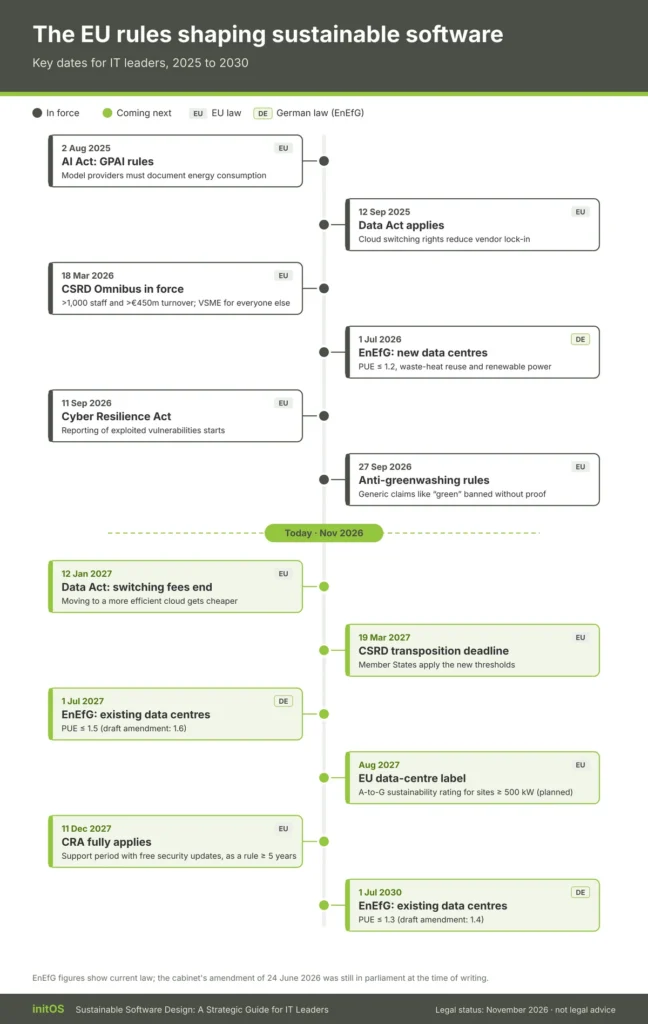
No single EU law says “write green code”. Instead, seven legal frameworks, plus Germany’s Energy Efficiency Act, each pull software decisions in the same direction: measure energy, extend product life, minimise data and prove every environmental claim.
Law | Status (November 2026) | Who is directly affected | What it means for software design |
|---|---|---|---|
CSRD as amended by the Omnibus I Directive (EU) 2026/470 | In force since 18 March 2026; national transposition due by 19 March 2027 | Companies with more than 1,000 employees and more than €450 million net turnover | IT energy use and cloud emissions feed into ESRS climate disclosures. Smaller suppliers are out of scope but still receive data requests from customers who report. |
Energy Efficiency Directive (EU) 2023/1791 + Delegated Regulation (EU) 2024/1364 | Reporting in force; EU rating scheme adopted by the Commission on 21 September 2026, labels planned from August 2027 | Data centres with at least 500 kW installed IT power | Data centres report energy, water, waste heat and renewable share. A public A-to-G label will make hosting choices visible to customers and investors. |
German Energy Efficiency Act (EnEfG) | In force since November 2023; an amendment passed by the federal cabinet on 24 June 2026 is still in parliament | Data-centre operators in Germany, and indirectly their customers | Current law requires existing data centres to reach a PUE of 1.5 from July 2027 and 1.3 from July 2030; the draft amendment would relax this to 1.6 and 1.4. Hosting choice becomes a compliance question. |
AI Act (EU) 2024/1689, amended by the Digital Omnibus on AI (EU) 2026/1744 | GPAI obligations binding since 2 August 2025; Omnibus in force since 27 July 2026 | Providers of general-purpose AI models | Technical documentation must include the model’s known or estimated energy consumption. Deployers should expect energy questions in AI procurement. |
Reporting duties since 11 September 2026; full application 11 December 2027 | Manufacturers of products with digital elements, including software | A declared support period (as a rule at least five years) with free security updates. Long-lived, updatable software becomes a legal requirement and a sustainability win. | |
Applies since 27 September 2026 | Any business making environmental claims to consumers | Generic claims such as “green” or “eco-friendly” are banned unless backed by recognised excellent environmental performance. “Green software” marketing needs evidence. | |
GDPR (EU) 2016/679, Art. 5 and 25 | In force since 2018 | Every organisation processing personal data | Data minimisation, storage limitation and privacy by design also cut storage, backup and transfer energy. |
Applies since 12 September 2025; switching charges end on 12 January 2027 | Cloud and data-processing service providers and their customers | Easier cloud switching reduces lock-in, so customers can move workloads to more efficient providers and regions. |
Two points are easy to miss. First, falling out of CSRD scope does not end the conversation: the Commission adopted a voluntary standard (VSME) for companies below 1,000 employees in July 2026, and large customers still ask their suppliers for data. Second, the EU is moving step by step from reporting, to rating, to possible minimum performance standards for data centres. The Commission opened a consultation on binding standards on the same day it adopted the rating scheme.
The timeline below shows the key dates at a glance.
Five principles of sustainable software design
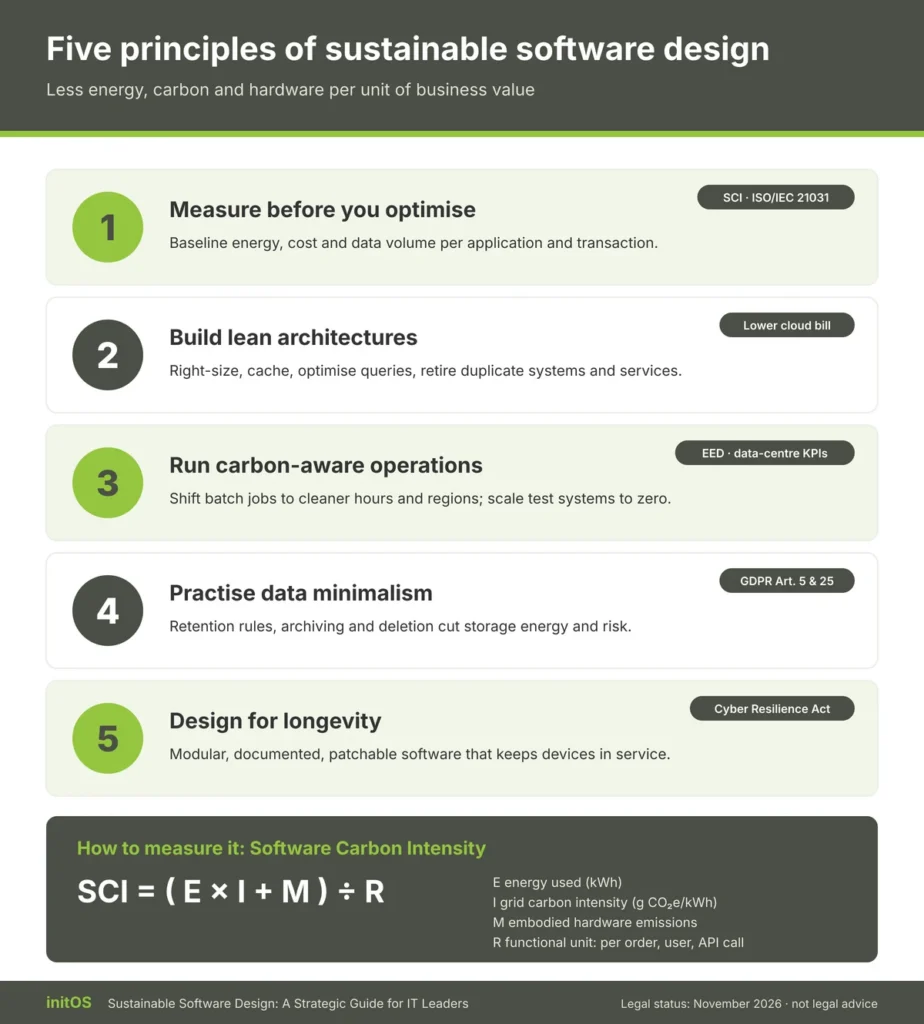
The most effective programmes rest on five principles. Each one saves energy and, in most cases, money, which is what makes them easy to defend in a budget meeting.
1. Measure before you optimise
You cannot manage what you do not see. Start with a baseline per application: energy or cloud cost per transaction, server utilisation and data volume. Use the Software Carbon Intensity (SCI) method described below so results are comparable over time.
2. Build lean architectures
Right-size before you scale. Avoid duplicate systems and unused microservices, cache aggressively, optimise database queries and shrink payloads. Consolidating overlapping tools (for example, several departmental apps into one modular ERP) often delivers the largest single saving.
3. Run carbon-aware operations
Not every job must run now. Shift flexible workloads such as reports, backups, model training and batch imports to times and regions with cleaner electricity. Scale non-production environments down at night and at weekends.
4. Practise data minimalism
Every stored gigabyte is backed up, replicated and kept on powered disks. Retention rules, archiving and deleting unused data reduce energy use and GDPR risk at the same time.
5. Design for longevity
Modular, documented, open-standard software can be maintained and patched for years. That protects your investment, keeps older end-user devices usable and matches the Cyber Resilience Act’s demand for long support periods with security updates.
How to measure software sustainability
The most widely recognised method is the Software Carbon Intensity (SCI) specification from the Green Software Foundation, published as the international standard ISO/IEC 21031:2024. It expresses emissions as a rate per functional unit, so a growing business can still show improvement.
SCI = \frac{(E \times I) + M}{R}- E: energy consumed by the software (kWh)
- I: carbon intensity of the electricity used (g CO₂e per kWh), location-based
- M: embodied emissions of the hardware, allocated to the software’s share of use
- R: the functional unit, for example per order, per user or per API call
In practice, most IT leaders track a small set of KPIs alongside SCI:
KPI | What it shows | Typical source |
|---|---|---|
SCI per transaction (g CO₂e) | Carbon efficiency of an application | Cloud provider carbon tools, energy metering |
Average CPU utilisation (%) | Over-provisioning | Monitoring (e.g. Prometheus, Zabbix) |
Idle and non-production resources (%) | Waste outside business hours | Cloud cost reports |
Stored data growth (GB per month) | Data minimalism progress | Storage and backup reports |
PUE of hosting location | Data-centre efficiency | Provider disclosures, EED database |
Average device and server lifetime (years) | Hardware efficiency | Asset management / ITSM |
Tip: cloud cost per transaction is a good early proxy. In most environments, a lower bill and lower energy use move together.
A 12-month roadmap for IT leaders
You do not need a new department. A four-phase roadmap, owned by IT and supported by finance and compliance, delivers measurable results within a year.
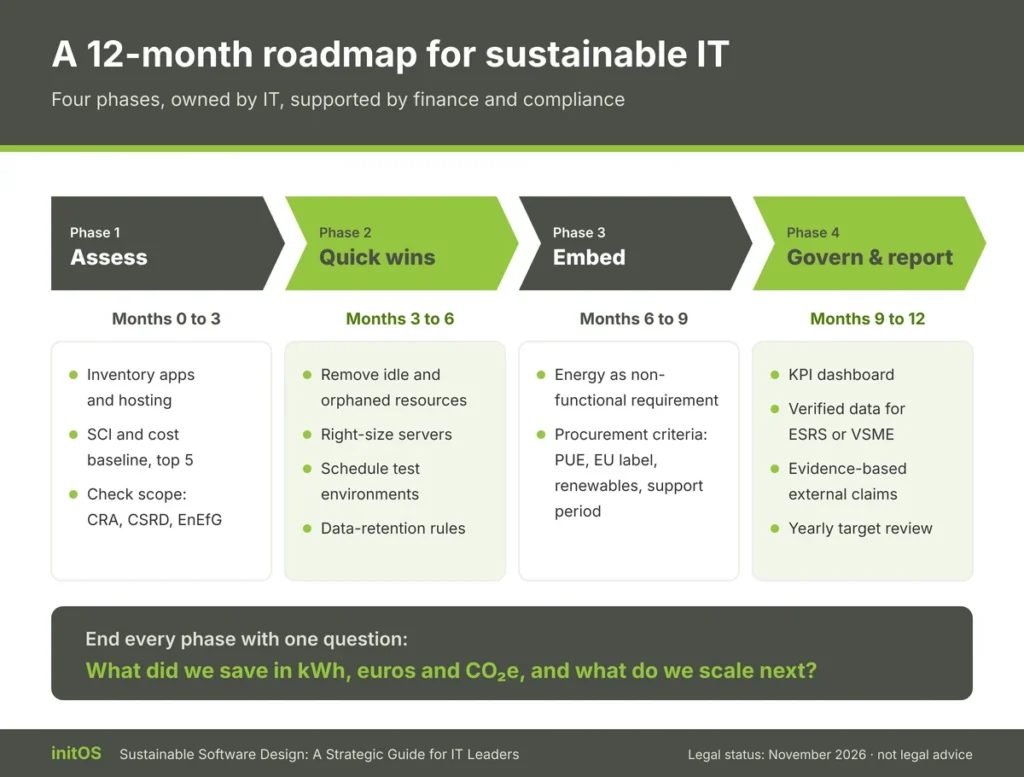
- Assess (months 0 to 3): Inventory applications and hosting. Set an SCI and cost baseline for your top five systems. Check which laws apply: are you a CRA manufacturer, in CSRD scope, or a supplier to companies that are?
- Quick wins (months 3 to 6): Switch off idle and orphaned resources, right-size servers, schedule test environments, introduce data-retention rules and retire duplicate tools.
- Embed (months 6 to 9): Make energy efficiency a non-functional requirement in architecture reviews. Add sustainability criteria to procurement: hosting PUE and EU rating, renewable share, support period and update policy.
- Govern and report (months 9 to 12): Publish an internal KPI dashboard, feed verified data into ESRS or VSME reporting, and review targets yearly. Only now communicate externally, with evidence.
Each phase ends with a short review: what did we save in kWh, euros and CO₂e, and what do we scale next?
Avoid greenwashing: talk about results, not labels
Since 27 September 2026, the Empowering Consumers Directive treats unsupported generic environmental claims as unfair commercial practices. It mainly targets consumer communication, but B2B marketing that reaches consumers, or is repeated by customers who sell to consumers, can be caught too. The proposed separate Green Claims Directive was not adopted, so national unfair-competition law (in Germany, the UWG) remains the enforcement route.
Practical rules for your website, tenders and product pages:
- Replace adjectives with numbers. Not “our green platform”, but “we cut energy per order by 28% between 2025 and 2026, measured with the SCI method”.
- Name the scope. Say which system, which period and which emissions are covered.
- No neutrality claims based on offsets. Claims that a product is “climate neutral” because emissions are compensated are banned for consumer communication.
- Future goals need a plan. A target such as “net zero by 2030” needs a public, time-bound implementation plan with independent monitoring.
- Keep the evidence file. Store baselines, methods and data so you can substantiate any claim on request.
The 28% figure above is an illustrative example of claim wording, not a benchmark.
Conclusion: efficiency, compliance and cost point the same way
Sustainable software design is where three agendas meet: lower operating cost, EU compliance and credible ESG data. IT leaders who start now with a baseline and a few quick wins will be ready when data-centre labels arrive in 2027 and the CRA applies in full.
Ready to start? initOS helps companies in Germany and across Europe build lean, maintainable business software on open source, from ERP consolidation with Odoo to hosting and long-term maintenance. Talk to our team about a sustainability assessment of your application landscape.
Sources
Legal status checked on 5 November 2026. This article is general information, not legal advice.
- Directive (EU) 2026/470: CSRD Omnibus thresholds and timeline (Hayot Expertise)
- CSRD reporting timeline after Omnibus I (Dcycle)
- From reporting to rating: the EU’s next steps for data centres (Freshfields)
- Commission proposes mandatory sustainability label for data centres (Latham & Watkins)
- Energy performance of data centres (European Commission)
- EnEfG-Novelle bringt Entlastung für Rechenzentren (CMS)
- Update Rechenzentren: Gesetzentwurf zur Änderung des EnEfG (Gleiss Lutz)
- Energy efficiency requirements under the EU AI Act (White & Case)
- EU Digital Omnibus on AI enters into force (Hunton)
- EU Cyber Resilience Act (NCSC Ireland)
- Cyber Resilience Act: what SMEs need to know (Ebner Stolz)
- Empowering Consumers Directive two years on (Mayer Brown)
- Green Claims Guidance, March 2026 (Cradle to Cradle)
- Primary texts on EUR-Lex, linked in the legal table above
Outgrown your legacy ERP system?
Contact us!
Get hands-on guidance for your Odoo implementation, configuration, and successful go-live transition.
Your Next Step
Do you want to learn about Odoo?
Choosing ERP system is only the first step. The real growth happens when you have a partner who understands your business processes. We specialize in mapping complex operational needs to flexible, open-source architectures that keep you in the driver’s seat.

Latest Posts
Sustainable Software Design: A Strategic Guide for IT Leaders
Sustainable Software Design: A Strategic Guide for IT Leaders Table of Contents Sustainable software design is no longer a CSR side project. In the EU, it now touches energy law, cybersecurity law, consumer law and sustainability reporting, and it directly shapes your cloud bill. For CIOs, CTOs and IT directors in Germany and across Europe,
How to Set Up Any AI in Odoo 20
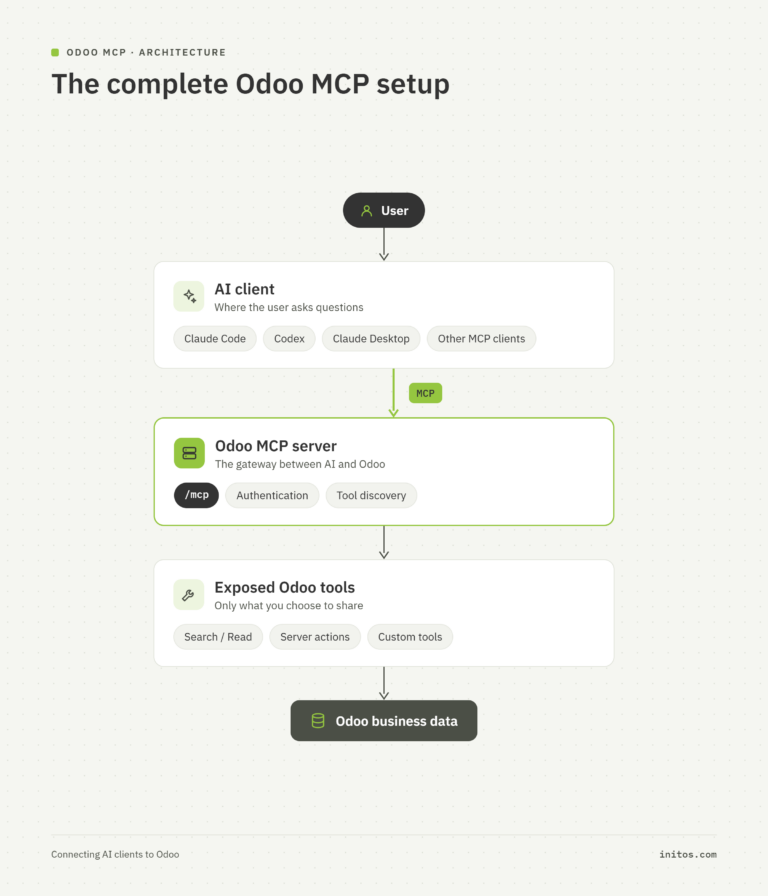
How to Set Up Any AI in Odoo 20 Table of Contents AI in an ERP used to sound like a feature for the future. That has changed. Odoo 20 already uses AI for tasks such as natural-language assistance, content generation, document processing, and support workflows, while it also introduces an Odoo MCP server that
To be able to load the contact form, you must allow external services