
The Ultimate Guide to RAID Log: Mastering Risks, Issues, and Dependencies
Using RAID Logs to streamline your Odoo 19 Migration
Often during a project development life cycle, many project managers or companies struggle with project planning and its execution. These struggles can be caused by multiple factors that vary depending on the size and nature of the projects. However, some of the most common terms that one can encounter in almost every project development life cycle, which can affect projects, are Risks, Issues, Assumptions, and Dependencies.
Although these terminologies are easily distinguishable based on their literary meanings, they are also easy to mix up in the context in which they are used. Specifically, in project management or software development, it is always hard to draw a fine line between them and to clearly state which specific problem falls under which specific category. This intermingling of categories can easily overwhelm a project manager, leading to poor project planning, and this domino effect could easily cost a company in terms of time, effort, resources, and most importantly, money.
Luckily, to tackle this problem early in the projects planning and development, there are some tools available that are designed to address this specific issue and one of the most prominent among them is the RAID Logs.
Definition of RAID Logs
RAID logs are a comprehensive tool used in project management to track and manage key elements that can influence the outcome of a project. The acronym RAID stands for Risks, Assumptions, Issues, and Dependencies, each representing a critical aspect of project planning and execution. By maintaining a RAID log, project managers and stakeholders can systematically monitor, discuss, and address these elements. This structured approach allows teams to proactively manage risks, validate assumptions, resolve issues, and coordinate dependencies. Ultimately, RAID logs help improve the project’s chances of success by providing a clear and organized way to handle the various challenges and uncertainties that arise during project execution.
Lets understand each aspect of RAID Log in depth.
What is a Risk?
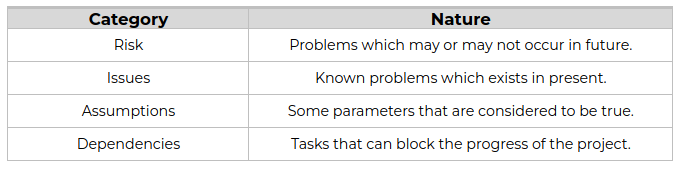
A risk is like a potential pothole on the road of your project. It’s something that might happen in the future and could cause problems or delays. Think of it like planning a road trip, you know there is a chance you might hit bad weather or traffic, even though it hasn’t happened yet. These are risks because they could affect your trip (or your project) if they do occur.
In project management, risks are events or situations that could negatively impact your project if they happen. The key thing about risks is that they are uncertainties, they might or might not occur. That’s why it’s important to identify them early and have a plan to deal with them if they do happen. By preparing for risks, you can minimize their impact and keep your project on track.
What is an Issue?
An issue is like a flat tire on your project’s journey. Unlike a risk, which is something that might happen in the future, an issue is a problem that has already occurred and is currently affecting your project. Think of it like driving your car and suddenly realizing you have a flat tire. You can’t ignore it, you need to deal with it right away to keep moving.
In project management, issues are current problems that are impacting your project’s progress. They could be anything from a team member being unexpectedly unavailable to a supplier delivering materials late. Because issues are already happening, they require immediate attention and action to resolve. By addressing issues promptly, you can minimize their impact and get your project back on track.
What is an Assumption?
An assumption is like taking a shortcut based on what you believe to be true. Imagine you’re planning a surprise party for a friend. You assume they’ll be available on a certain date, that your favorite venue will have space, and that your friends will confirm their attendance on time. These are assumptions because you’re basing your plans on beliefs that you haven’t confirmed yet.
In project management, assumptions are things that you believe to be true but haven’t verified. They could be about resources, timelines, stakeholder support, or any other aspect of the project. Assumptions can be helpful for moving forward, but they also come with risks. If your assumptions turn out to be wrong, they can lead to problems and delays. That’s why it’s important to identify your assumptions early on and validate them as much as possible to minimize potential issues.
What is a Dependency?
A dependency is like a domino effect in your project. It’s a task or activity that relies on another task being completed first. Imagine you’re baking a cake. You can’t frost the cake until it’s been baked and cooled down. The frosting depends on the cake being ready first.
In project management, dependencies are tasks or resources that your project relies on to move forward. They can be internal, like one team member’s work depending on another’s, or external, like waiting for a supplier to deliver materials. Dependencies can also be sequential, where one task must finish before another can start, or parallel, where tasks can happen at the same time but still influence each other.
Understanding and managing dependencies is crucial because they can impact your project’s timeline and resource allocation. By identifying dependencies early, you can plan accordingly and avoid delays.
To summarize the above explanation, you can also refer to the following cheat-sheet.
Looking for a Future-Proof IT Strategy?
Get in touch with us!
The foundation of every successful IT project is a well-thought-out strategy. We begin with a no-obligation initial consultation to understand your business, your goals, and how technology can move you forward.
RAID Log Example
Let’s look at the example to understand this tool in a better way. We will go through the scenario that is highly relevant to us as initOS and might also be the case that you can relate as well if you are planning to implement and integrate Odoo into your day-to-day business.
This example sketch a high level picture of how we would migrate a Odoo to version 19.
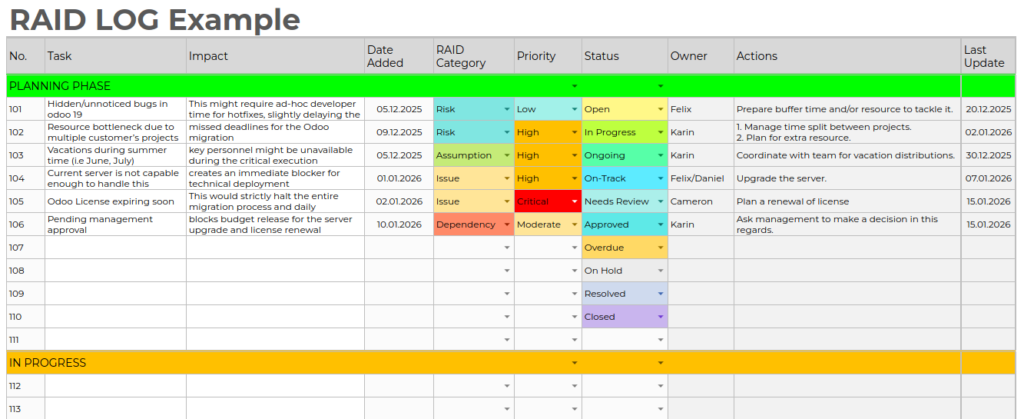
This template consist of 10 columns:
- No. Which assigns a unique number to each Task
- Task Define the details of the problem or the task
- Impact Which defines the impact of this task
- Date Added When the task was added to the RAID log
- RAID Category is used to define the associated aspect of RAID Log for the given problem
- Priority defines the criticality of the problem
- Status shows the status of the Task
- Owner column shows the responsible person for a specific problem
- Actions state what actions are needed to solve the problem
- Last Update highlights when the latest action is taken to resolve the problem
Moreover, you can also add a column like Updates Description to describe the progress made so far in addressing the issue. RAID Log templates are highly customizable and can be shaped or reshaped according to the project’s complexity.
While working with RAID Log, there are also two additional things that need attention:
Since the RAID Log is an important document in the project development life cycle and can also act as a single source of truth to monitor the project’s health, it is important to understand that this document needs frequent updates. If it is left neglected, it will become easily out-dated, and all of the project’s track record will be lost.
Although defining an ownership (Owner column) is not the core aspect of the RAID Log, it is a must-have feature. It helps create transparency among the stakeholders working on the project and also provides better accountability
Pros & Cons of RAID log
Like any other project management tools RAID Log also comes with some Pros and Cons.
Pros of using RAID Log
- Improves coordination across multiple teams.
- Helps track multiple risks, issues, and dependencies effectively.
- Supports proactive decision making and issue resolution.
- Enhances communication with stakeholders.
- Serves as a single source of truth for project health.
- Enables strong ownership and visibility across the project.
Cons of using RAID Log
- Can become time-consuming to maintain if not managed properly
- May add administrative overhead, especially for small projects
- Can become outdated quickly if not reviewed regularly
- Risk of over-documentation if too much detail is captured
- Effectiveness depends heavily on discipline and ownership
- May give a false sense of control if items are logged but not actively addressed
Exciting industry news and updates on open source, Odoo and initOS solutions in our newsletter.
Subscribe now!
To be able to load the contact form, you must allow external services
RAID Log: Complicated vs Simple Projects
So far, we have created a good understanding of the RAID Log as a project management tool. Now let’s understand where we can apply this tool to make the project management process a bit less problematic.
The RAID Log can be used in numerous different types of projects. It has wide applicability across different projects and domains. There could be multiple debates found on the internet regarding whether the RAID Log is really applicable in SME projects or if it is an overkill, or whether it is really that beneficial for large enterprise projects or not. However, I dare to have a different opinion on this. Rather than comparing use cases based on the size of the company, we should consider this comparison in terms of the complexity of the projects.
The usage of RAID Log in the complex/complicated and simple projects can be defined as follows
Complicated Projects
- Used to identify and track a large number of risks, issues, assumptions, and dependencies across multiple workstreams.
- Helps manage inter-team and external dependencies, including vendors and third parties.
- Supports early identification of high-impact risks and escalation to senior management.
- Provides a structured way to prioritize issues and define mitigation actions.
- Enables clear ownership and accountability for each RAID item.
- Acts as a central reference point during status reviews and governance meetings.
- Improves visibility and transparency into overall project health.
- Supports informed decision-making in environments with high uncertainty and change.
Simple Projects
- Used to capture only the key risks and issues that could impact delivery.
- Helps teams stay organized and focused on what really matters.
- Makes important assumptions visible so they can be validated early.
- Provides basic visibility into project health for managers.
- Supports quick decision-making without heavy documentation.
- Acts as a simple reference checklist during regular team check-ins.
Conclusion
Developing, updating, and managing a RAID log can become overwhelming, and without the right expertise and structure, managing the entire project development life-cycle can feel circular and unproductive. This ongoing challenge often leads to frustration and limited progress. If you are looking for an experienced IT consultant to manage your project effectively and remove the complexity from your project or product development, we are here to help. Please feel free to contact us, we would be pleased to discuss how we can support your goals and ensure successful delivery.
Did you find this guide helpful? We share practical project management insights, Odoo expert tips, and industry updates regularly on our LinkedIn page. Join our community to ensure you never miss a strategy that could save your next project time and money.
To be able to load the contact form, you must allow external services
Latest Posts
RAID Log Guide: Risks vs. Issues in Project Management | initOS
The Ultimate Guide to RAID Log: Mastering Risks, Issues, and Dependencies Using RAID Logs to streamline your Odoo 19 Migration Often during a project development life cycle, many project managers or companies struggle with project planning and its execution. These struggles can be caused by multiple factors that vary depending on the size and nature

Odoo 19 Features | initOS
New Features of Odoo 19 Odoo 19: AI-Powered Workflows, Smarter Operations, and Limitless Scalability In the world of Enterprise Resource Planning (ERP) software, updates are often incremental—a button moved here, a report tweaked there. However, every few years, a release comes along that fundamentally shifts the baseline of what businesses expect from their software. Odoo